the NFL and Sam, hopefully a love story

Michael Sam is gay.  That’s a statement that is getting so wonderfully pedestrian; it’s wonderful to think that in most cases the immediate response would be, “Who cares?”  For Michael Sam, it’s a little more noteworthy, though.  Sam is a defensive linemen for Missouri, and about to enter the NFL Draft.  If drafted (he’s expected to go in the middle rounds), and if he makes the roster of whichever team drafts him, he’ll be the first openly gay player to play in the NFL, or in any of the four major American sports.  That’s worth talking about.

Something else that’s noteworthy about Sam is his integrity.  The fact that he’s gay has not exactly been kept under a tight lock; he came out to his entire team last year.  His team, and his coaching staff was very supportive of him for the rest of his college career.  But the fact that he decided to come out publicly to the media before the draft is incredible.  Sam easily could’ve kept his orientation under wraps until after the draft.  He could’ve come out after he had secured a place on an NFL roster, and nobody – myself included – would’ve criticized him for that.

That’s not what Sam did, though.  He made it a point to publicly declare his homosexuality before the draft, before he’d signed a contract, before he earned they payday he’s been working towards for years.  That was an intentional decision for him.  He told ESPN in an interview,

“I just want to go to the team who drafts me, because that team knows about me, knows that I’m gay, and also knows that I work hard. That’s the team I want to go to.”

He doesn’t want a team drafting him without knowing in full what they’re getting.  He’s even putting his future career at risk.  It’s not out of the realm of possibility that all 32 teams decide that they don’t want to deal with the inevitable controversy drafting him will bring.  But Sam thinks it’s more important that a team knows exactly what their signing when they draft him.  That’s class at a whole new level.

So how does Sam’s prospects look, being the first openly gay player to enter the draft?  It’s tough to tell.  Other leagues in North America have such different reactions to dealing with homosexuality, they’re not much a predictor.  While most leagues are taking active steps to stop homophobic language, they way they handle gay players varies.

Last year NBA player Jason Collins came out after entering free agency.  He was the first active player in one of the four major sports to come out.  While that was an important step, the fact is that no NBA team was willing to sign him to contract after he came out.  The league claims that Collins’ coming out has nothing to do with why he hasn’t found a new team, but it’s tough to imagine it’s not a factor.

MLS midfielder Robbie Rogers also came out last year while he was playing in England.  Rogers did get a contract, and spent half a season with the LA Galaxy.  Even more heartening, there were no reports of blowback from fans, other players, or coaches.  Everyone seems fully supportive of him, and the only criticism he’s faced is based strictly on his play on the field.  However, MLS isn’t considered to be a major sport in America, and subsequently Rogers’ exposure has been limited.

So the question remains, how will the NFL deal with an openly gay player potentially in the league?  If the past is any indication, it doesn’t seem hopeful.  It’s not like the NFL is known for being the most gay friendly community in the world.  Just one month ago, former Vikings punter Chris Kluwe claimed that he was fired just for speaking out for gay rights.

Homophobia and the NFL go hand in hand.  One columnist said that the NFL set the standard for homophobia, pointing out that the NFL is the only major league who has yet to fine – or even punish in any way – a player for using an anti-gay slur.  There’s even players who claim they’ve been questioned by teams about their sexual orientation at the NFL combine (pre-Draft workout).

So what can Sam expect?  Let Keith Olbermann explain how things seem to be going so far:

If you didn’t spend the 5 minutes to watch that, you should.  Olbermann discusses a number of current and former NFL scouts and executives who don’t think the league is ready for an openly gay player, all while strictly keeping their own anonymity.

That kind of cowardly attack on Sam is extremely troubling.  Just the other day I was discussing how one of the best virtues of professional sports is the fact that it’s a meritocracy.  Ideally, it shouldn’t matter in the slightest what color, gender, religion, or sexual orientation a player is.  If they play well, they’ll earn a spot.  But apparently a number of NFL execs don’t see it that way.  That’s the kind of tired prejudice I would expect out of a player like Richie Incognito, not the top brass.  Speaking of that, since Incognito is the poster boy for bigoted culture in the NFL, did he have anything to say about Sam?

Ooooh… that can’t look good for the execs.

I’m hopeful things work out well for Sam.  I want nothing more than for some team to take a chance on him and give him an honest chance to prove himself.  He should be judged on his ability, and nothing else.  I’m proud to live in a time to see somebody as brave as him take this step.  I’d be even more proud to see my optimism for the league justified.

At the very least there’s this:  The Westboro Baptist Church have already announced that they’ll protest Sam’s school this weekend.  If ever you do something that brings those hateful bastards out in protest, chances are you’re doing something right and worthwhile in your life.  So Michael Sam, I thank you for that.

Attack of the non-sports fans.

The Super Bowl is something that we, as a society, mark pretty much every year.  Things here in western Washington are particularly frantic and excited this year because of the Seahawks’ second Super Bowl appearance.  It seems everywhere you turn there’s blue and green jerseys, flags, banners, and most especially the number 12 plastered everywhere.

SeahawksSkyline12Seattle 24×7

Subtlety hasn’t been a strong point in the city of the last few weeks.

As the vast majority of us gather together under a 12th Man banner to support our team’s championship run, there are others who are a bit less excited about the the focus on football in the area.  There’s a lot of non-sports fans out there who aren’t shy about making it known that they couldn’t care less about the Seahawks, and wish everyone else would just shut up already.

They have a point, too.  Seahawks fever is ubiquitous, and for those out there who don’t want to be a part of it, they’re frustratingly unable to escape. I went through a similar experience in high school.  Way back in the 1990’s, the Mariners made a magical run from being 12 games out of first place in their division to winning the division and beating the Yankees in the playoffs in what is probably the greatest single play in Mariners history.  To this day, Mariners fans get chills hearing Dave Niehaus’ call of Edgar Martinez’ double down the left field line.  Macklemore even wrote a song about it.

I, however, wasn’t so thrilled.  I hated sports back then.  I thought they were frivolous (which, even though I love sports now, is still true).  But in fall of 1995, I couldn’t escape it, and it angered me.

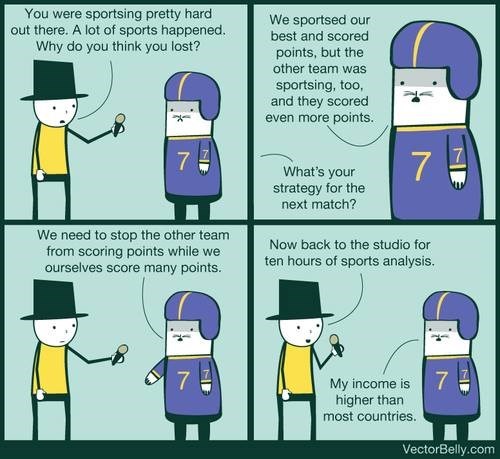
Here’s the problem, though.  While I’m not without sympathy for people who don’t like sports, that doesn’t change the fact that I get irritated by some of the reactions I hear.  During the weekend of the NFC Championship game, I saw this little cartoon on my Facebook feed no less than 5 times:

h615AF66AVectorBelly

First of all, I’m going to gloss over that last line about what the athlete makes; I feel I covered that in enough detail already.  What’s interesting about it, though, is the sense of intentional ignorance.  The entire joke of the comic is that sports are meaningless if you don’t understand them and because they’re meaningless, they’re not worth understanding.

Here’s the thing, though.  There’s not a lot of dumb people I’m friends with.  Intellectual curiosity runs rampant in my circles.  So I don’t understand how people would not only choose to be ignorant on a subject – especially one that is important to so many other people – but to actually proud of that ignorance.

This is an attitude I see in conservative religious circles regularly.  Creationists don’t understand evolution, and don’t want to.  They’re proud of their lack of knowledge.  I once had a conversation with a fundamentalist co-worker, and asked him what he knew about evolution.  He said, “It’s about the big bang and stuff, right?”  He was absolutely, 100% convinced that evolution is wrong, but knew nothing about it.

head-in-the-sandhousebandwidth.org

The picture of Phil Robinson looks similar, but his head is in something else.

How is it different with people who make “sportsball” jokes?  I can’t think of a single situation where ignorance is superior to understanding.  There’s plenty of subjects that I don’t find interesting enough to learn about – and I’m sure my non-sports fan friends consider football to be in that category – but I would never be proud of my ignorance of those subjects.  I’m not really a naturalist.  I don’t like being outdoors, and I don’t know much about what’s out there.  However, I only mention it here to make the point.  I don’t tend to announce my ignorance of nature casually in public, and I don’t post it on Facebook every time my wife wants me to go hiking.

I also took issue with the fact that it had to be during the build-up to the game and the game itself that the anti-sports comments became the loudest.  I understand that it’s during a game day, when the cacophony of fandom reaches its highest levels that those who don’t care feel the greatest urge to let everyone else know about their displeasure.  Yet, as a fan, that displeasure is a discordant note that echoes through an otherwise exciting time.  I don’t want to say that people who don’t enjoy sports should just keep silent.  What I am trying to say is that I think some of the motivation for people to loudly proclaim their disinterest during a game is to ruin it for everyone else.

This is hardly an uncommon attitude.  People, by their very nature, have a cavalier attitude about ruining things they aren’t interested in.  I remember a particular example of this a few years ago when I was waiting outside Borders bookstore for the midnight release of the 7th Harry Potter book.  I was standing outside the store about a half hour before the book was going to be released when some teenagers drove by shouting spoilers they’d read on the internet.  They didn’t like Harry Potter, so they thought it’d be fun to ruin the excitement for everyone else.

Or how about when Rosie O’Donnell, unimpressed by the film Fight Club, spoiled the twist ending on the very day the movie was released.  Today Fight Club’s twist seems almost cliche, but at the time it was shocking.

imagesVibe

“That’s not even the douchiest thing I did in my career!”

The point is, there’s a tendency for people who don’t like something to spoil it for everyone else.  When it happens to you about something you enjoy, it’s infuriating.  I’ve struggled with doing that in my past, I even wrote a post about it.  It’s fine not to enjoy sports, but it’s not fine to try to infringe on other people’s enjoyment of it.

Look, I understand people who don’t enjoy sports; like I said, I’ve been there myself.  It’s just that sometimes it seems that the outcry against the enjoyment of sports is louder than it needs to be.  A friend of mine once wrote something to the effect of, “There are more people on my Facebook feed hating sports than people liking it.  Who knew I would survive to see the day when football fans were the counter-culture hipsters.”

UnknownThe Other 87

“We prefer to be called futbol fans.”

If you don’t enjoy sports, that’s fine.  But let those who do enjoy it do so in peace.  Next time you want to speak up because everyone’s talking about something you don’t care about, just scroll on by.

…..

So before I wrote this post, I talked to my wife about it.  I told her that this post, more than any, would probably open me up to accusations of hypocrisy.  I’m pretty sure there have been situations outside of sports in which I did the very same thing I’m railing against here.  That’s fine, on it’s own.  A part of my writing this blog is to explore issues and find situations where I’m being inconsistent, and work on those.  My most successful post by far was a such situation where I candidly discussed failing to live up to my own standards.

As my wife and I were discussing this, I thought of a perfect example of my own inconsistency with the above article.  See, as an atheist, I’m constantly reading news about the latest atheist billboard or advertisement to get rejected.  Or when they’re not rejected, they’re vandalized.  This is so common there’s an entire page dedicated to the vandalized atheist billboards.

No one rejects or vandalized christian billboards, but atheist billboards are considered so offensive by some that they can’t leave them alone.  Even completely innocuous ones with statements like, “Don’t believe in god?  You’re not alone.” are vandalized.  Once an atheist group tried to design an atheist ad to be as non-offensive as possible.  They developed an ad with only the word “Atheist” and a couple websites.  It was rejected.

imagesAtheist Billboards

Godless bastards are even ruining kittens now. Have you no shame!

I get angry about this… a lot.  Too many people think my very belief system is offensive.  People want me to shut up.  People think I should move to another country.  Hell, once a sitting president said he didn’t consider me a citizen.  Atheists are often told stay silent about their beliefs, or that it’s not the right time, or that they have no tact.  The problem is, there never seems to be a right time.  My beliefs are always offensive to some, so instead of always being silent, I refuse to.

So in all fairness to you anti-sports friends of mine, I may not be in the position to complain.  It is against my values to tell anybody to be silent.  I may not agree with some of your reasons, but that gives me no reason to tell you to scroll past in silence.  Let the arguments continue.

Hard work, Dedication. Why athletes deserve every penny they’re paid.

The NFL is unquestionably big business.  The amount of money that flows into the league from its numerous sources is staggering.  The success of the league is also one of the it’s biggest criticisms as well.  It’s next to impossible to have a conversation with someone who’s not a fan of sports (as well as many who are) without the subject of overpaid athletes coming up.  It’s been the subject of tired rants and predictable conversation, and that’s not gonna stop anytime soon.  To steal a line from a different article, saying athletes are overpaid is probably the most uncontroversial statement someone can make about sports.

But do athletes really make too much?  Well, if it’s such an uncontroversial statement to suggest they don’t, I’ll be controversial:  Athletes earn exactly what they should.  It’s rare that I’m accused of being a fiscal conservative, but this is one situation where I think free market economics are right on.

lebron-james-money-261x300_display_imageUglyBoyFresh.com

Admit it, a part of you is just jealous.

The first objection that’s raised to the idea that sports stars earn their money is that there’s all sorts of other vocations that don’t make as much.  This argument usually sounds something like this:

“Teaching is one of the most economically important occupations because our future economy relies on the education of its youth, yet teachers are paid astronomically less than the average professional athlete is… Furthermore, police officers, firefighters, and doctors save lives while risking their own for a fraction of what sports stars make. People in the military leave their families at home to defend and protect the country knowing they may never return.”

Trust me, I’m well aware of what a teacher makes; my wife is one, and supports both of us with her meager salary.  You’re not gonna find a bigger advocate for raising teacher’s wages than me.  Same goes for all the other public service jobs.  Police, firefighters, soldiers… hell, I’ll even say politicians could use a bump in pay.  Perhaps if we paid them more, they wouldn’t pull so much corrupt bullshit to make more money.

alg-resize-rod-blagojevich-jpgNew York Daily News/Olsen/Getty Images

On second thought… scratch that last one.

But there’s a problem with that logic.  As I said, those are public jobs.  If you think teachers deserve more money, then pay them more!  Raise taxes across the board.  Fill the public coffers and demand that these people who do so much for our society – from the police who protect us to the road workers who fix the potholes for us – get paid what they deserve.  But the voting record shows that we as a society are not willing to do it.  Every time someone suggests raising taxes to give teachers a raise, screams of over-taxation and communism assault us.

Athletes on the other hand, are being paid with private money.  It’s not your cash.  If you don’t think athletes deserve the pay they’re getting, great!  Don’t buy jerseys; don’t go to games; don’t watch on TV.  Congratulations, not a penny of your money is going to pay for athlete’s wages.

Turn-off-the-TVprince.org

“Really?  That’s all I had to do?”

See, professional athletes are a part of a private business, and they make huge sums of money because they bring huge sums of money into their industry.  Lebron James will earn over $19 million this year.  That’s a lot of money – to put that in perspective, he probably will make my wife’s annual salary with every basket he makes this season.  The Miami Heat, are willing to pay that, though, for LeBron and Chris Bosh (who, believe it or not, makes exactly the same as James) to play along side their own star, Dwayne Wade, because that brings money into their franchise.  Since they started playing together, those three stars have led the team to the NBA finals every season, winning the last two.  And I certainly wouldn’t bet against them to go all the way again this year.  Championships mean money for the Heat organization.  Championships drive ticket sales and television deals.  The Heat made an investment in Lebron and Bosh, and that investment is paying off huge in trophies, glory, and – most importantly to the team owners – money.

Another objection I often hear from non-sports fans is that athletes only play a game instead of providing something useful to society.  It’s a comment that’s usually delivered with a heavy side of condescension.  And you know what, in part, they’re right.  Sports, by its very nature, is frivolous.  Sports neither ends wars nor changes governments.  It doesn’t educate or discover.  It only exists to be admired and enjoyed.

Wayne-Rooneys-spectacular-bicycle-kickDaily Football News

Meh, doesn’t look all that hard.

That, however, doesn’t change the fact that sports stars don’t just play a game; they play a game better than anybody else on the planet.  The top-level, multi-millionaire athletes are top-level because they are the very best at what they do.  Peyton Manning is earning $17.5 million this year because he is the best quarterback the NFL has ever produced (as proven by the Broncos first Super Bowl appearance since John Elway was their quarterback).  Manning makes that much money because no one else in the world can play QB like he does.

Sports aren’t the only industry that works like that.  What does your average accountant make?  $50K?  $75K for a really good one?  What about Kevin Hayes, FD for British investment firm Man Group?  He makes £2.5 million (roughly $3.7 million) annually.  He makes that kind of money because he’s the very best at what he does.  The most talented people in most industries make much more money than average.  But since most of their salaries aren’t published in the newspaper every year, nobody pays much attention.

UnknownEducationCareerArticles

“Same wages, but less bling.  Bling isn’t deductible.”

Part of what makes the economic structure of sports so effective is the fact that sports, unlike almost any other industry in this world, is a true meritocracy.  How many corporate directors have you heard about paying themselves huge bonuses after losing their companies millions?  Or even worse, people who profit on the ashes of companies that they’ve invested in and destroyed?  Or even people who buy into companies, than pocket so much of the profits that the company folds, only to blame it on the laborers.

That’s not how things work in the sports world.  If you can’t play, you lose your job.  It’s that simple.  Those who consistently perform at a high level get to leverage that ability into a higher wage.  If they can’t keep their high level of play, though, nobody will pay them.

Furthermore, I would even suggest that sports is one of the few places where the drivers of the industry are actually paid fairly.  This isn’t like McDonald’s posting 10 or 11 figure profits while most of their employees are on food stamps.  Athletes produce the product that drives the sports industry, and earn the profits from that industry.  Not only do they earn the money from the product they produce, but they also provide profit for the investors and team owners as well as providing living wage salaries for most other people in the industry.

380px-Baseball_player_by_Keith_AllisonWikimedia Commons

“So you’re saying I basically flip burgers for a living?”

Also, sports is not an industry in a vacuum.  Countless other businesses and jobs rely on sports to survive.  There’s a reason that the major TV networks are willing to pay $27 billion for the rights to air NFL games.  In the modern climate of DVRs and streaming television, live sports are the only real draw TV has anymore.  If those end, then the networks fold. Without the power and financial support of the networks, you not only will lose all the good (and bad) programming being produced, but everyone whose job relies on television is out of work.  I’m not only talking about TV stars who make seven figures an episode, but every single person whose livelihood depends on television will be jobless.  Everyone from the cameramen to the props specialists and set designers.  Even the drivers and the caterers will all have to find new markets for their skills, and there just won’t be any.  Thousand upon thousands of people without work, and no new jobs for them to fill.

All the journalists who cover sports, and all the publications that depend on sports to bring readers in would also fold.  Without sports, the economic collapse in society would be traumatic.  And without athletes, there’s no product to support the sports industry.

In any other industry, the average wage of the producers of the product would be much lower, and it only be the directors and shareholders who benefit from the profits earned.  Paying athletes less doesn’t change the amount of money flowing into the major leages.  If athletes weren’t earning all that money, then the league and the team owners would be getting it, and that’s hardly fair either.  Who do you think deserve to be paid more, the players that put their bodies on the line for the game, or the owners who provide the setting for the athletes to play?  Team owners certainly deserve a return on the investment they made on the team, but not at the expense of the people on the team itself.

jerryWashington Post/Joe Robbins/Getty Images

“I assure you, if it were up to me I’d be paying them minimum wage.”

And finally, there’s the fact that your average career of an athlete is brutally short.  It takes a limitless amount of dedication and hard work from a very early age to become a successful athlete.  All that work could end at any time.  I’ve already discussed at length what a brutal sport football is to the human body.  While most sports aren’t that hazardous to its players, the potential for a career-ending injury is always present even in the most low-impact sports.  Even if an athlete is lucky enough to avoid that fate, they’re considered past their prime by 30 and ancient by 40.  Considering the dedication needed to even reach that high level, most athletes spend most of their time and energy when their young focused on the game to the detriment to the other aspects of their lives.  Consequently, they often finish their careers with few marketable skills and few options to support themselves.  The incredibly high wages leave athletes with a large cushion when they finish their careers.  With a little fiscal responsibility, they shouldn’t have to worry about their livelihood again, just like any other retiree.

Long story short (too late), yes athletes make a lot of money; in some cases, obscene amounts of money.  But those wages aren’t just handed to them for no reason.  It took years of battling with team owners before athletes started earning what they deserved.  I will never make as much as the average NFL player, never mind one of the top NFL players, but that’s because I will never be as good at anything in my life as the average NFL player is at what he does.  And that’s just reasonable.

Bread and Circuses – Is the NFL too dangerous to continue?

On February 17th, 2011, Dave Duerson, former NFL Player killed himself.  Duerson was a defensive back for the Chicago Bears in the 80’s.  He was a two time Super Bowl Champion.  In his post football life he built up a successful business.  But as he approached the age of 50, he started having trouble putting together coherent sentences.  He was feeling depressed, and was also experiencing severe pain on the left side of his brain.  He eventually committed suicide.

Duerson’s death was tragic, but the method of his suicide was notable.  Instead of shooting himself in the head like most suicides by gun, he shot himself in the heart.  Duerson knew there was something wrong with his brain, and he wanted to be sure not to damage it further in his death so that it could be studied after the fact.

What researchers found was the Duerson suffered from chronic traumatic encephalopathy, or CTE.  CTE is a degenerative condition usually found in professional boxers.  It’s caused by repetitive brain injuries, an can lead to depression, memory loss, and even dementia.  Duerson wasn’t the first NFL player to succumb to CTE, more than 20 players showed evidence of it after their deaths.

Football is a brutal sport, and Duerson’s story shows how the effects on the body from playing it can last the rest of a player’s lifetime.  Depression, moodiness, violent behavior, and suicide are all too common among current and former NFL players.  The effect of concussions received during the game isn’t entirely understood, but long lasting harm can no longer be denied.

Even for players who avoid brain injuries and their consequences, the physical toll of the NFL is extreme.  Former Dolphins linebacker, Jason Taylor, once discussed at great length the medical work he would have to go through just to play through the pain during his career (warning:  that article is not for the feint of heart).  Taylor said the pain was so bad that,

““There was a period of a year and a half or two years when I couldn’t put my kids to bed,” he says. “My wife and I laugh about it. You have to bend down. I couldn’t with their weight. I would just hover. I would get as low as I could, and then drop them, and they’d bounce.”

Taylor tells about when his leg pain was so bad when he laid down that he tried sleeping while standing up on his stairwell.  But he doesn’t regret it.  He said,

“Would I do it all again? I would… If I had to sleep on the steps standing up for 15 years, I would do it.”

Players, of course, are highly compensated for putting their bodies on the line for the game.  NFL contracts sometimes reach the nine figure level.  The minimum pay a player can make is a pretty significant sum.  But then again, it has to.  The average career in the NFL is between 3 and 4 years (despite what the league office says).

So why do we support this game?  Why is it that every week, I sit down to watch, cheer, rave, and rant about every play?  The drama of the sport is unquestionably compelling, but that alone doesn’t justify supporting the system that puts players through the hell that they go through.  And let’s be clear, I am supporting that.  Everytime I turn on a game, everytime I buy a jersey, everytime I put my time, money, or voice into the NFL, I am tacitly supporting their product.  I am saying that I think it’s worthy.

The most common reason to dismiss the danger is that the players themselves choose it.  They want to be there, and they work hard to make it there.  I accepted that argument myself for a long time, but I recently had to change my mind on it.  My friend Sam and I were discussing this issue, and he argued that players can’t actually consent to the way they’re treated because they’re indoctrinated from a very young age to put the team ahead of their own health or needs.  One doesn’t become a top level player in any sport without working at it for years before hand.  And those years are spent within a culture that celebrates hard work, playing through pain, and giving everything to win.  By the time a player makes the NFL, are they really choosing of their own will, or are they just following the indoctrination that they’ve lived with for years?

Also, there’s the pressure of playing at the top level.  For every player starting on an NFL team, there’s a throng of players behind him that want that job.  Being injured means possibly losing your position to someone else.  How many people remember Don Majkowski?  Majkowski was a pretty good quarterback for Green Bay, leading the league in passing yards in 1989.  However, he tore a ligament in September of 1992 and was replaced by a young QB named Brett Favre.  Majkowski spent the rest of his career playing back-up for other teams.

Every time a player chooses to play through an injury and put themselves at further risk, they do so because of a combination of coming up within a sports culture that encourages risky behavior in the name of success, and the inherent threat of losing their position to someone else who is willing to play through the pain.  It strains credulity to believe that players’ consent is not driven by outside factors.

As mentioned earlier, there’s also the level of financial compensation players get.  Football may be rough on a player’s body, but a 10 year career can enough to live for years to come.  It’s tough to argue against that.  But again, when you hold up a pile of money next to someone’s life, that pile of money seems much smaller.

The fact is, I can’t really say why I support the game.  I’ve often considered walking away because the cost on the players’ lives is just too much.  But here I am, still thrilled at the chance to watch the Seahawks win a Super Bowl.

I think I feel there’s enough good in the game that it might make up for the problems.  I feel that the dangers can be mitigated, if not alleviated.  The question is whether or not the league office can be believed when they say they’re trying to make the game more safe.  Some of the changes they’re considering seem to imply a serious attention to the safety of their players.  But talk is cheap.  Are those changes actually going to be implemented?

Things in football were much worse, once upon a time.  A century ago the game was so dangerous that player deaths were not only possible, but somewhat common.  Teddy Roosevelt, hardly known for being a shrinking violet, called for the first reforms of the game in 1905.  The game has changed a lot over the years, and it will probably continue to change.  In effect, football goes through a constant battle to find the balance between an exciting game and the safety of its players.  Once upon a time, a few deaths a year was seen as perfectly acceptable.  Today, serious concussion issues lead people to think perhaps it’s time for the game to end forever.

I fall somewhere in the middle.  I love the game.  I love the community and the excitement.  I love the drama and the intrigue.  But I’m ready for some serious culture changes.  I think it’s time to stop lauding players for playing through injury.  I think it’s time to change the racist team names and mascots.  I think it’s time to start banning players who regularly injure other players.

Mostly, I think kids who start playing football – and their families – must be informed and educated about the dangers of the game.  Dave Duerson never knew what the game would do to his brain and his body when he started playing.  Today we are much better informed, and I think young players must benefit from that knowledge.

There’s a lot wrong with the sport that can be changed.  But I don’t think it’s time to end the game entirely.  There’s still enough good in the game that it’s worth saving.

Sherman’s march through the internet.

Quick post today.  If you’re like me, you were paying close attention to Seattle’s win yesterday against the 49er’s for the NFC Championship title.  It was hard-nosed, tough football of the type you don’t often see these days.  My heart was in my throat until the very end.  And what an end it was.

richard-sherman-michael-crabtree

Jonathan Ferrey/Getty Images

When’s the last time you saw a picture of a team’s season ending?

Strangely enough, the only thing anyone seemed to want to talk about after the game was the post game interview rant by Richard Sherman (that guy up in that picture).  Sherman is brash, loud, and unapologetically egotistical, so it was no surprise to anyone who knows about him when Fox sideline reporter Erin Andrews put a mike in front of him moments after he made a career play that sent the Seahawks to the Super Bowl and he responded in his usual brash manner.

“Well, I’m the best corner in the game! When you try me with a sorry receiver like Crabtree that’s the result you are going to get! Don’t you even talk about me!”

That rubbed a lot of people wrong… and I mean a *lot*.  Social media exploded with comments about Sherman, calling him classless or thuggish. Plenty of people even attacked him with racist comments (that link is disappointing disturbing).

This story has been covered from so many angles, and by so many people that I hesitated to even talk about it myself.  Even Sherman himself wrote a piece about it.  Others have talked about the history between Sherman and Crabtree which led to his rant.

For my own part, I’m both entertained and bewildered by the attention this story is getting.  I don’t understand how in a back and forth, bare-knuckle-boxing-match of a game this could be the story every one wants to focus on.  There were so many fascinating storylines in that game, both of the wonderful, and the terrible variety.

Take Seahawks special teams player Jeremy Lane.  During a punt in the first half, Lane was forced out of bounds (perfectly common occurrence), and was either pushed or shoved or hit by someone standing in the 49ers bench area (not so common an occurrence).  This nameless 49er could’ve been a coach or a non-active player.  Whoever he his, he clearly hit Lane during a play without the refs noticing.

Then there’s 49er’s defender NaVorro Bowman, who was having a monster game until a freak accident injured his leg in the second half.  Bowman’s leg got caught under a Seattle receiver during a tackle, and early reports are that he tore his ACL (meaning he’ll be recovering until the beginning of next season if he’s lucky).  In a disgusting display of stupidity, one or more Seahawks fans threw food at Bowman as he was being carted off the field of play.  That’s an act of such despicable classlessness that Seahawks fan group Hawk’s Nation released this statement on Facebook.

“To the fans who threw food at Bowman as he was being carted off the field… The stud LB and a respected warrior on the field had hurt himself to the point of where he couldn’t walk and had to be assisted off. Shame that these few ******** would do such a disgraceful thing at a players lowest moment.

“He played his heart out and sacrificed himself for our entertainment, and you decide to degrade him by throwing something. You should be ashamed of yourself. Do the rest of us 12’s a favor and stop going to games. Stay home. You surely don’t deserve to be at the game and are a prime example of showing the world what’s wrong with being a fan.

“I’m sincerely sorry for such actions and hope Bowman has a quicky, healthy recovery after suffering an ACL injury.”

Or how about actually talking about the game?  How about discussing the way 49er’s QB, Colin Kaepernick, ran for over 130 yards per game making him the only QB in NFL history to have more than one 100+ yard running games in the playoffs.  Or the fact that Seattle running back Marshawn Lynch burst for a 40 game-tying touchdown run, which was his 4th 25+ yard playoff TD run -twice as much as any other player in NFL history.  All the rivalry drama aside, it was an amazing game.

There were all sorts of stories to talk about, but nobody wants to talk about any of them.  They want to talk about Richard Sherman.  And they want to call him classless.  In a sport where you hear story after story of players in trouble with the law, this guy is considered classless.  In a sport where a coach was suspended for an entire year for paying his players extra to injure opponents.  There are a lot of things wrong with the NFL, but Richard Sherman isn’t one of them.

He’s loud and arrogant, but he backs it up on the field.  He plays the game right.  He made a game-saving play that sent his team to the Super Bowl.  And he was pumped up about it, and talked some smack about a player he has some history with.  I see no problem with that.

And just because of all the racist crap that was thrown his way, by the end of the week I’ll be wearing my own Sherman jersey.

** Update **

It took a bit of financial finagling, as well as a compromise with the wife, but mission accomplished

.IMG_0734 IMG_0735

A little love for humanity, and a biblical prophecy I might actually believe.

I know I do a fair bit of ranting and complaining on this blog.  I would say it’s actually my primary purpose here.  I created this blog as a space where I can speak out about things I find important.  Usually the stories I’ll write about are the ones that make me most angry.

But to make sure that I don’t entirely get swallowed up by my own misanthropy and disappointment in the world, I thought I might take a chance to tell some stories that are a little more affirming.  None of these stories have anything to do with the schism between theism and non-theism.  They’re just stories I’ve found that are uplifting, fun, or interesting and they might not get the recognition they probably deserve.  I also picked quite a few sports-related stories, mostly because that’s just how I roll.

Lastly, before I get into some stories, I have to credit the last episode of the Thinking Atheist podcast for both inspiring this post, and telling me about one of the stories.

So with no further ado, here’s a few tales to make you like the world a little bit better.

This first one goes back a bit.  Here’s a video someone posted of his proposal to his girlfriend about a year and a half ago.  This video is the one of the most beautiful things I’ve ever seen.  I know there’s a story behind it somewhere.  I know there’s all sorts of interesting facts about the development and planning behind it, but I don’t want to hear about those.  This is a video that is almost perfect as it is, without the complications surrounding it.

Next, an 80’s hair metal band called Steel Panther played a show in Kansas City, MO last month.  An 11 year old fan who came to the show with is dad held up a sign challenging the band’s guitarist to a guitar solo duel.  The boy was invited on stage where he floored the band and the entire crowd.  Watch this video, it will make you grin.

Next we go to Dallas, Texas.  AutoSource Dallas, a local car dealership, accidentally ordered 80 pizzas for an event they were hosting.  Rather than refusing the extra pizzas, they paid for all 80 of them, grabbed a car, and started delivering the extra pizzas to homeless people around town.

Out of all these links and videos, I think this is the one I like the best.  If you’re gonna watch any of them, take 10 minutes to watch this one.

The Make A Wish Foundation is one of the most brilliant and amazing charities out there.  The work they do to give kids chance to have uniquely amazing experiences is unparalleled.  But last year, when Atticus Lane-Dupre asked for the chance for his entire little league team to play against the Portland Timbers, over 3000 members of the Timbers Army made sure that his experience was more special than the charity could’ve possibly hoped.  This is such an amazing story that it even got me to say nice things about the Timbers.

Speaking of sports rivalries, the Seahawks and the 49ers are developing a fascinating one.  First there’s the story about the brick that Seahawks fans bought.  See, the 49ers are moving to Levi Stadium, their new home starting next year.  Levi Stadium will have what’s called the “Fanwalk” where fans can buy personalized bricks engraved with their own message.  Seahawks fans put together $1000 to buy a brick of their own, so there will always be a pro Seattle message at the 49ers home.  Since the brick only cost a third of the money the fans raised, they donated the rest of it to the family of Brian Stow, a San Francisco fan who was brutally attacked outside Dodger Stadium a few years ago.

49ers fans responded.  After more Seahawks fans paid to have a 12 man flag flown over Candlestick Park before the Seahawks vs 49ers game a few weeks ago (extra funds donated to the Wounded Warrior Project), San Francisco fans put together a fundraiser to buy a billboard in the Seattle area.  The did eventually get billboard space, but missed Seattle by a few miles by getting an electronic billboard in Fife.  Even I had to put together a little meme to commemorate that one:

BcHS_8cCYAE8bko

But what was best about the billboard fundraiser is that all the money that didn’t go to pay for the billboard was donated to Seattle Children’s Hospital.  These fans are proving that this is a rivalry with class on both sides.  I wish the Sounders and Timbers fans would learn this lesson, and perhaps their rivalry might grow to be more fun.

Sports and charity stories tend to be related.  For example, if you’re a fan of the NFL, you know that they levy hefty fines for all sorts of actions.  Players and coaches have faced fines for excessive touchdown celebrations, taunting other players, and even wearing the wrong colored shoes.  And these get expensive.  NFL fines add up to $2 to $3 million a season.  But where does all that money go?  Turns out, it’s all donated to charity.  The league office and the players union agree on which charities will benefit from fines.  When a player is fined, the notification includes which charity will receive the money.  After the earthquake in Haiti in 2010, the Red Cross was given over $600,000 of NFL fine money.

While we’re on the subject of NFL fines, perhaps you’ve heard recently that Seahawks running back Marshawn Lynch was fined $50,000 by the league for refusing to speak to the press all season.  Seattle fans decided that was unfair, and put together a fundraiser to pay the league.  Of course, Lynch is not exactly strapped for cash, so instead of using the money raised to pay his fine, he said he would match whatever funds he received and donate it all to charity.  Lynch even appealed the fine, and doesn’t have to pay it, but will still give a matching donation for the fundraiser to charity.  Everyone wins!

And one final bit about Marshawn Lynch.  Turns out that his game this weekend against New Orleans very well may have been prophecized in the bible.  Some enterprising biblical scholar – who I would love to credit if I knew who it was – found this obscure passage: Revelations 13:7

“Also [the beast] was allowed to make war on the saints and to conquer them.”

Bring it on, Brees and the rest of you Saints.  I’ll leave you with one other biblical passage.  Romans 8:31, “…and if god is for us, who can be against us.”

Wow… I almost sound like a believer.  Fancy that.

2013 was great for gay rights, for the most part.

2013 is over, and in many ways it was a great year for LGBTQ rights.  Gay rights support is at an all-time high, and the massive surge of states approving marriage equality continues to rush through the nation.  Fully half of the 18 states (plus DC) that have legalized gay marriage did so in 2013.  The Supreme Court declared the Defense of Marriage Act of 1996 unconstitutional, as well as refusing to rule on the appeal of California’s Proposition 8 (effectively declaring it, too, unconstitutional).

gay_flag

I guess you could even call it a banner year. Zing!

However, it seems there have been as many setbacks as victories for the movement.  As many court cases, legislative bills, and public votes approving gay marriage as there were, there are even more states which staunchly hold to their belief that gay couples don’t deserve the same rights as straight couples.  Conservative pundits and activists continue to scream and yell about how the gays are the cause of everything from hurricanes and earthquakes to the complete collapse of western society.

Thankfully on the legislative side, they’re mostly reduced to drafting impotent bills that address imaginary problems.

r-MITCH-MCCONNELL-large570

“Next we’re gonna pass a law banning sasquatch from public parks.”

However, that doesn’t change the fact that there continues to be a serious opposition to gay rights in this country, and that opposition is almost entirely based on religious values.

It seems to me that the sports world is a microcosm of the greater gay rights debate.  2013 was a landmark year for gay equality in sports.  Most prominently, there was the story of NBA player Jason Collins who came out as gay in Sports Illustrated.  Collins marked the first time an active player in one of the 4 major sports in America (football, baseball, basketball, and hockey) was openly gay.

Sadly, Collins made his pronouncement as his contract with the Washington Wizards was coming at an end, and he has yet to find a new team.  While his age (35) certainly is partially responsible for his difficulty finding a place to play, it strains credulity to suggest that his coming out has nothing to do with it.

130429024012-jason-collins-profile-single-image-cut

This is the face of an NBA pensioner.

Collins did face some level of push back both within and outside the sports world, though.  ESPN analyst, Chris Broussard said that Collins couldn’t be gay and Christian at the same time.  Also, spokesman for the American Family Association, Bryan Fischer, worried about Collins looking at other players in the shower.  Collins responded to Fischer’s absurd complaints with more calm and rationality than I probably would be able to manage, saying, “Believe me, I’ve taken plenty of showers in 12 seasons. My behavior wasn’t an issue before, and it won’t be one now. My conduct won’t change.”

Before that, in February, US soccer player Robbie Rogers came out on his website, saying he had to leave the game to, “discover myself away from football.”  However, his retirement didn’t last long, and he returned to MLS in the summer, becoming the first openly gay men’s athlete to play in a major league in America.  It was an incredible story, and one that the league website considered one of the biggest of the year.

283437_heroa

And let’s face it, now that Beckham’s gone, he’s the Galaxy’s dreamiest player too.

One of the most heartening aspects of the Rogers story is that while he’s struggled both with injuries and with consistency on the field since joining the LA Galaxy, all criticisms of the team’s trade is focused on his play, without bringing up his sexual orientation.

Yet as the LGBTQ community makes impressive strides forward in the sports community, there is the inevitable steps back.

In September of 2012, Maryland state delegate Emmett C. Burns Jr. wrote a letter to the Baltimore Ravens’ head office to demand they silence one of the players who was speaking out in favor of marriage equality.  Vikings (now former) punter, Chris Kluwe, wrote a brilliantly biting and profanity ridden response to Burns which was published on the website Deadspin (if you’ve never read it, I urge you to click that link. It’s amazing).

images

If for no other reason, to find out the context for the term “lustful cockmonster”.

This little experience put Kluwe in the spotlight in ways NFL punters rarely experience.  He responded with great aplomb by spending much of the year pointing out hate, bigotry, and corruption wherever he saw it, and publishing a book about his opinions of society.

After last season, Kluwe was released by the Vikings.  While at the time this seemed like an innocuous roster move by the team, Kluwe has recently alleged that it was a mix of his activism and a homophobic coach which led to his firing.  The former punter can’t prove that is the case, but he lays out some compelling arguments for it.

Of course, proving discrimination when terminated from a job is not easy.  I had a situation myself once where I was – and still am – convinced that I was fired because I’m atheist.  I worked for awhile under a boss who was deeply religious and evangelical.  When he found out I was atheist, he constantly harassed me about it.  He would call me immoral, and constantly bring to me various “proofs” of god’s existence.  When the company was having financial troubles and had to lay off an employee, I was the one who was laid off.  I can’t prove that it was because of my atheism, but I do know that there were 5 possible employees that were producing at the same level I was, and any of them could’ve been laid off in my place.  From what I know of my boss, I’m sure that he picked me because of my beliefs.  Again, though, I can’t prove it.

images-1

“I assure you, this is for purely economic reasons.”

Sports is rife with homophobia.  Whether it’s former baseball players using the same tired arguments that were debunked when Don’t Ask, Don’t Tell was repealed, or the general machismo-filled culture of an entire league, you can’t get away from it.  And as Kluwe pointed out in his recent article, there’s a price people pay when they try to change a culture for the better.

65957-1Fr

This is a man who doesn’t understand the idea of a hostile work environment.

The part I can’t figure out is this, though.  Outside of religious texts, why is there any objection to LGBTQ rights?  The conservative evangelist crowd has made it clear where they stand.  They flock to restaurants in solidarity when the CEO makes bigoted comments.  They scream and yell about freedom of speech and buy books by the masses when their favorite reality stars get suspended for hateful remarks.

Every major organization that’s opposed to marriage equality in this country, be it the American Family Association, the National Organization for Marriage, or the United States Conference of Catholic Bishops, all of them are religious based.  According to Wikipedia’s list of opponents to same-sex marriage, of the around 70 organizations listed, virtually every one of them was religiously based.  And I don’t meant to suggest that it’s only extreme right-wing Christianity that’s fight against marriage equality.  Wikipedia’s list includes mainline Christians, Jews, Muslims, Hindus, and even Rastafarians.

But if you take away the religious objection, what’s left?  That some people think gays are icky?  I can’t imagine anyone would think that’s a reasonable reason to write laws based upon.  Is there anything else?

Unknown

“They’re too well dressed, maybe?  I’m sorry, I only speak in stereotypes.”

I’ve posed this question before.  If it weren’t for the biblical prohibition on homosexuality, is there a single good reason to oppose gays?  I have yet to hear a single answer to that, compelling or not.

That’s what’s gets me so angry about religion.  There is nothing wrong with gays.  They are wonderful and productive members of society who want nothing more than the same public acknowledgement of their relationship that the rest of us get.  Only to the religious could that be seen as something terrible.  Only to the religious could two consenting adults loving each other how they want be seen as a threat to society.  They may say empty platitudes like “hate the sin, love the sinner,” but those sayings are pure BS.  You can’t claim to love a person while at the same time act to restrict their rights.

But what about that biblical prohibition?  For a moment, let’s stipulate that the Bible is absolutely correct when it comes to gays.  It’s sin, and it’s immoral, and there’s no arguing about that.  We’ll ignore the numerous objections, debunkings, and debates about any of those points.

Guess what, given all of that, it still doesn’t matter.  The bible – contrary to what idiots like David Barton say – is not the foundation of all American law.  If you don’t believe me, take a look at the Ten Commandments that conservatives want to plaster in every courthouse and capitol building in the country.  In case you couldn’t remember what they were, here’s a refresher.  How many of those laws have similar incarnations in US law?  As I count it, two and a half.  Number 6 – thou shalt not kill – which in our law comes with numerous caveats and exemptions; number 8 – thou shall not steal – which is pretty universally accepted regardless of a culture’s religious affiliation; and finally number 9 – thou shalt not bear false witness against thy neighbor.  I give number 9 half credit because there are certain instances in which bearing false witness (perjury) is explicitly forbidden, but in general it’s actually protected under freedom of speech.

So that’s it.  Two and a half out of ten.  Not exactly a rousing endorsement for biblical law.  Gay rights should be exactly the same.  You have the right to be opposed to them if you want, but the law should be equal.

I have failed you.

Hey all, I just wanted to write a quick apology.  I took a pretty long break over Christmas with only two quick posts, but I promised to write more regularly after I returned.  Here it is a week later and once again, I’ve only posted twice.  I don’t really have a good reason for it besides that I haven’t been inspired much this week.

I however have had a wonderful New Years party with some close friends.  So that excuses one day (and honestly, the brutal hangover I had the next day certainly inhibited any writing as well… totally worth it).  I’m gonna get something down later today, then probably take the weekend off again (sorry, but there’s NFL and Ask an Atheist related stuff going on this weekend).  So coming Monday, I’m gonna get back to it.. 5 posts a week.

Hope you all had as glorious a holiday season as I did.  I couldn’t ask for a better time with family and friends, both new and old.  Here’s to some more regular blogging by yours truly.